End of Year Sale: "A Nocturne In Red"

The Smashwords End of the Year Sale begins today and runs through January 1. 

Now is your best chance to snatch up Court Ellyn's novella, "A Nocturne In Red" for 75% off! That means this quick read (normally priced at $4.99) is now only $1.24 for the next two weeks. Find the download button at this link:  https://www.smashwords.com/books/view/1480370  

Is this novella for you? Grab it and give it a go.

Blurb:

Sanjen Laurelius, a lute-wielding bard, is a rising star.

He's also wanted by the emperor.

When he calls upon his special brand of song-magic to fight off a rampaging harpy, he finds himself the object of unwanted attention: a powerful officer in the emperor's service hires Sanjen to find the cure for a curse that has transformed a favored concubine into a bloodthirsty monster. But Sanjen's past is catching up with him. Can he find a way to save the victim of the curse before his employer discovers his true identity—and returns him to the emperor in chains?


NEW RELEASE: The Compendium, 2022

 LegendFire Critique Community is pleased to announce the release of its 2022 issue of THE COMPENDIUM. 

The subtitle, "Mundane Nightmares: Roots of Abandoned Dreams," is a way of creating unity among the past year's contest prompts. The challenges of 2022 pushed us to try genres we weren't comfortable with. None of us had ever written a Noir piece, yet this issue offers three of the community's attempts at the Noir genre. The issue also covers the regular territory of fantasy fiction, poetry, and memoir. The community's beloved 100 Word Weekly Challenge turned out a host of micro fiction as well.

We had no members volunteer art in time for publication, so we selected some gorgeous photography that illustrated the primary prompts. All interior images come from Unsplash and are copyright free, and all artists have been credited.

As always, The Compendium is FREE to download from Smashwords.


BLURB: 

The 2022 issue of LegendFire Critique Community's Compendium offers a selection of fiction, nonfiction, and poetry. Explore the dark nature of dreams, meet hardboiled criminals and cops, encounter stunning poetry, and consider the mundane made extraordinary.

The issue's longer works cover a broad variety of genres and a wide range of themes, from dreams gone wrong to leadership entitlement, human trafficking and persecution of minority groups. For readers short on time, a selection of hard-hitting micro fiction can be enjoyed in under a minute.

This sampling of LegendFire’s 2021-2022 contest entries promises flights of fancy inspired by prompts sprung on the community’s writers with little warning. The resulting prose and stanzas are thought-provoking, often startling and, we hope, inspiring in return.

Contributing authors: Patricia Denny-Purvis, Edward Drummond, Court Ellyn, Finn Warrick, Aidan Zingler

DOWNLOAD:

--> .mobi for Kindle, .pdf, plain text, and other formats: AT THIS LINK

--> .epub for Epub readers: AT THIS LINK


New Release: The Compendium 2021

 The Compendium: LegendFire's Annual Anthology, 2021 released for free at Smashwords!

LegendFire Critique Community is as pleased as punch to to announce the release of the premiere issue of its annual anthology, The Compendium. The subtitle of the 2021 issue, inspired by the community's first year of contest prompts, is "Rise From Ruin: Between Misadventures." We tried to fit every prompt in there, but the title was already a mouthful.

The first issue features 6 poems, 2 memoir anecdotes, 5 full-length short stories, and easily a dozen ultra-short pieces that can be read in seconds yet provide the full satisfaction of a longer tale. All this alongside 2 original art pieces rendered by digital artist Aidan Zingler.

As the critique community's membership grows, so too will the length and variety of the Compendium.


Blurb:

In the premiere issue of LegendFire Critique Community’s Compendium, journey through caves inhabited by ravenous darkness, flee the burning rays of a demon sun, tumble headlong through turbulent seas and accidental misadventures in true-to-life confessions, and much more. Encounter poetry to challenge and delight, tales from a broad variety of genres, memoirs that will elicit sympathy and laughter, and ultra-shorts that can be enjoyed in under a minute.

This sampling of LegendFire’s 2020-2021 contest entries promises flights of fancy inspired by prompts sprung on the community’s writers with little warning. The resulting prose and stanzas are thought-provoking, often startling and, we hope, inspiring in return.

Contributing authors:

Patricia Denny-Purvis, Court Ellyn, Tony Glass, Joyce Lewis, Melanie Rebro, Laurel Stark, Finn Warrick, Jeffrey V. Yorio, Aidan Zingler

Download:

The Compendium may be downloaded for free at Smashwords:

HERE


REVIEW: Nucleation by Kimberly Unger


Blurb:

We are live, we are live, we are live. . .

Helen Vectorvich just botched first contact. And she did it in both virtual reality and outer space.

Only the most elite Far Reaches deep-space pilots get to run waldos: robots controlled from thousands of lightyears away via neural integration and quantum entanglement. Helen and her navigator were heading the construction of a wormhole gate that would connect Earth to the stars . . . until a routine system check turned deadly.

As nasty rumors swarm around her, and overeager junior pilots jockey to take her place, Helen makes a startling discovery: microscopic alien life is devouring their corporate equipment. Is the Scale just mindless, extra-terrestrial bacteria? Or is it working―and killing―with a purpose?

While Helen struggles to get back into the pilot’s chair, and to communicate with the Scale, someone―or something―is trying to sabotage the Far Reaches project once and for all. They’ll have to get through Helen first.

~Amazon

REVIEW of Nucleation

written by Aidan Zingler of ReshapingReality.org


Overall Thoughts: For a science fiction tale, this book not only impressed me with its use of physics, specifically entanglement of particles, but blew me away with its scope of imagination. The characters leap off the page with such personality, and the book kept twisting and turning with surprises every step of the way.  

Plot Overview: The story follows the tale of an operator who works for a corporation exploring the far reaches of space. Helen plugs herself into the company's quantum entanglement system and sends her consciousness to a "waldo," where she operates robot machinery in a far away solar system. Her work is fairly mundane at first - eject the payload, which is the necessary ingredients for the nano technology (called "eenies") to collect matter around that system's star until enough is reached to build the jumpgate. Except Helen discovers that the spacecraft housing the payload is covered in a weird dust that shouldn't exist (all their eenies recycle all non-used stuff, so no dust or other matter should exist) but then a feedback signal fries her navigator's brains. This horrifying incident catapults Helen into a dangerous and wild mystery full of corporate espionage, possible aliens, quantum weirdness, and rivals trying to silence her attempts to find answers.

Thoughts on Characters: Helen, Keller, Ivester, Hofstaeder, and the rest of the cast all felt unique and superbly drawn. Each held motivations that overlapped or conflicted with others to create delightful tension. Also, PTSD and trauma were covered and dealt with in humane ways that made sense to the world and to the reality of how trauma actually affects humans, which was incredibly refreshing to see in a novel.

Plot Impressions: What a wild ride this was!! The plot followed a loose three act structure. It had me guessing and wondering where we'd go next, and just when I thought I figured out the mystery, a surprise unleashed which had me reexamining my theories. I felt that the ending was a bit abrupt, but then the ending does leave room for any sequels if the author wishes to explore this world and its unique technology again.

Recommend? Yes. Definitely worth the read!

My rating: 5 of 5 galaxies


This review may also be found on Aidan's Goodread's page.

Find Nucleation at your local library, your local bookstore, and these retailers:

Amazon

Barnes & Noble


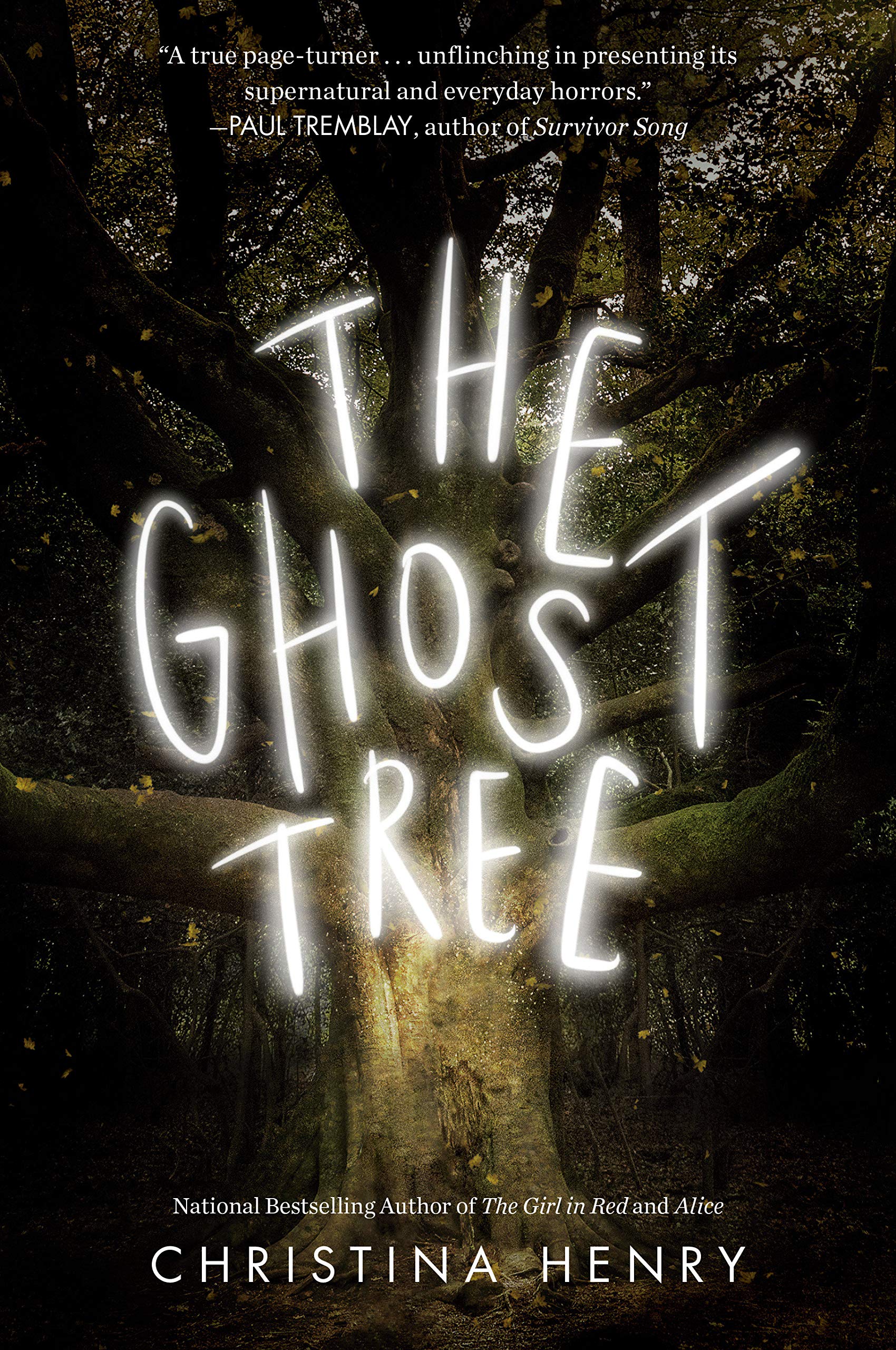
Review: The Ghost Tree by Christina Henry


BLURB:

When the bodies of two girls are found torn apart in the town of Smiths Hollow, Lauren is surprised, but she also expects that the police won't find the killer. After all, the year before her father's body was found with his heart missing, and since then everyone has moved on. Even her best friend, Miranda, has become more interested in boys than in spending time at the old ghost tree, the way they used to when they were kids.

So when Lauren has a vision of a monster dragging the remains of the girls through the woods, she knows she can't just do nothing. Not like the rest of her town. But as she draws closer to answers, she realizes that the foundation of her seemingly normal town might be rotten at the center. And that if nobody else stands for the missing, she will.

~ Amazon


REVIEW

Witches are real, as Lauren soon learns. And so are curses. Little does she know that her favorite tree is called the Ghost Tree for good reason.

Up front: the first half of the novel is a delectable horror story; the second half is YA paranormal mystery/thriller.

PROS

The Ghost Tree starts out chilling, disturbing, nauseating. It ends as a captivating, dark adventure. The novel is a fast read. That’s saying something. I’m a slow reader. I can dwell inside a novel for a month or two before I manage to finish it. This book took me about a week and a half. Speed readers could have it read in a day or two. This is because it’s an easy book, neither deep nor complicated. 

Fast pacing and clear, to-the-point writing keep you rolling along. As does the story itself. The story grabs hold and doesn’t let go. That sounds trite, but it’s true. In fact, I began to feel rather addicted. Though I had lots of responsibilities to see to, I kept sneaking into my cushy reading chair to devour another chapter or two. 

I loved our main character from the beginning. Lauren is adorable. Not in a “cute adorable” way, but in the “I adore you because I have so been there” way. Her innocence, awkwardness, and strength pulled at my heartstrings, and suddenly I remembered what it was like to be 14, which earned her my enduring pity.

The relationship interactions between Lauren and her mother, Lauren and her best friend, Lauren and Jake were one of the triumphs of the novel. Henry hit the teenage struggle right on the dot.

CONS

As much as I enjoyed the novel, there were several things that drove me nuts.

To-the-point writing. Wait, how is this a pro and a con, and why would to-the-point writing be a con anyway? This boils down to personal taste, but it affected me so hugely that I can’t not mention it. The narration was written in such a to-the-point way that it lacked poetry, artistry, complexity. Not once did I run across a line that caused me to stop dead in my tracks and gasp in glorious ecstasy, which is one of the reasons I read in the first place. Gorgeous word-craft, no matter the genre.

For all that, the writing voice seemed extremely appropriate for the main character (a 14-year-old girl) and readers of the same age. Except for the level of gore in the early chapters and once near the end, and the amount of promiscuous sexual activity by a 15-yr-old (none of which is shown or discussed in any level of detail), I would easily chalk this novel up as a YA.

I kept running across one of my pet peeves as well: felt/feel/feeling. When a writer studies writing, one of the tips we encounter is, “Don’t tell the reader how a character feels. Show them.” The word “feel” is used so often throughout the book that the word began to flash like neon. I started circling each use of the word. There are a couple sections where every other sentence has the word “feel” in it. See where I’m going with this?

I could be wrong, but I would say that this novel was written extremely quickly and handed over to an editor who knew the author’s work would sell because of past success.

Nor did the twist work for me. Almost as soon as “He” is mentioned, I figured out who “He” was. “He” is clearly our perpetrator. So obvious was the answer to this mystery that I began to wonder if Henry meant it to be a mystery at all. When “His” identity is revealed during the endgame, it wasn’t a twist in the slightest. Was this intentional? *shrug* I can’t say.

Lastly, I can’t say I was satisfied with the resolution either. I expected the last few pages to deal with the fallout of this tragic curse, [spoiler] for the town to outwardly, loudly mourn the deaths of their daughters and hell to rain down on a few heads. But the only result we see is the delusion lifting and being replaced by a kind of brain-fog or shock. All in all, I’d say the ending was rushed, the consequences whitewashed in order to bring the novel to a sudden conclusion.

TREASURES

Timely themes top the list. Among them: racism, police brutality, difficult teenage relationships. Henry handles these topics in a sensitive, believable manner. Their place in the story will resonate with contemporary readers.

CONCLUSION

I haven’t read a great deal of horror, but the horror novels I have read usually leaving me feeling dissatisfied. I am waiting for that horror novel that has me scared and/or disturbed from cover to cover.

The Exorcist has been the only one, to date, that has managed to accomplish this and provide glowing satisfaction by the time I read the last page. Granted, that’s a big shadow to follow. Is it fair to hold that classic up as the standard? Why not.

That said, I have invested in another of Henry’s novels. I shall embark upon Alice soon. I have been hoping and waiting for just such a take on Alice’s Adventures in Wonderland. Crossing fingers it’s everything I’ve hope it is.

In the meantime, I give The Ghost Tree 3 out of 5 magic wands:


Find The Ghost Tree at your local library or these retailers:


OTHER COVERS


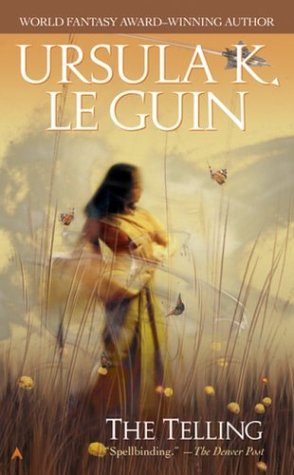
REVIEW: The Telling by Ursula K. Le Guin


The Telling: LeGuin, Ursula K.: 9780441011230: Amazon.com: Books
Published by Ace Books, 2000

Blurb of The Telling, Hainish Cycle #8:


Once a culturally rich world, the planet Aka has been utterly transformed by technology. Records of the past have been destroyed, and citizens are strictly monitored. But an official observer from Earth will discover a group of outcasts who still practice its lost religion-the Telling. Intrigued by their beliefs, she joins them on a sacred pilgrimage into the mountains...and into the dangerous terrain of her own heart, mind, and soul. With her intricate creation of an alien world, Ursula K. Le Guin compels us to reflect on our own recent history.


~Amazon

Review:

written by Aidan Zingler of ReshapingReality.org

Sutty comes from a tumultuous time in Earth’s history, where religion has bombed libraries and universities. She travels to the planet Aka as an observer in hopes of studying a world of rich history, where equality is paramount. Except by the time her ship finally arrives, the world does not match the reports of the original Ekumen observers. Technology has utterly transformed it. The Corporation strictly monitors the citizens in their March to the Stars, and all books and stories of their history have been banned and eradicated. Her first few months are spent under rigid control by the authorities, where she is given propaganda and nothing that she can truly study. 

Within the first chapter, we learn that Sutty's request for passage out of the capital city is finally granted by bureaucrats. So she travels north to a small town in the foothills of the mountains. Here she uncovers the once rich society of the Telling. People here risk much to keep their stories alive.  Intrigued by their beliefs, Sutty joins them on a sacred journey into the mountains. It is there, deep in the highest caverns of the mountains, that she delves into her past, these peoples’ past, and how it all intertwines here on this planet far from Earth.

Being a Master of Science Fiction, Ursula K. Le Guin does not disappoint, and she weaves a masterful story about philosophy, societal change, and the depths people go to keep their traditions alive. The characters are vibrant and interesting, full of quirks and flaws. Even the Monitor — one of the Corporation’s agents — has surprising depth, once Sutty has the chance to talk to him outside of the strict confines of the Corporation. All of the dissidents — the Maz, storytellers — leap off the page with a glorious richness.

Not to be outmatched by the characters, the twist in the tale unravels through a discovery Sutty makes which surprised me in a delightful way. Despite the novel's small stature, the richness of the world-building and the characters shine with the brilliance of stars.

I highly recommend the novella as each page begs to be turned. It’s science fiction at its best — exploring humanity in all its idiosyncrasies.

5 out of 5 galaxies:


Pick up "The Telling" at your local library, your local bookstore, or these retailers:

Book Release: A Nocturne in Red


REP is pleased to announce the release of "A Nocturne in Red," a novella first published in August 2018 by the Society of Misfit Stories.


The ebook is available at Amazon HERE, and the print version HERE. According to Amazon's Matchbook program, if you purchase the print version, you can download the digital version for free. And the print version is truly lovely.

About the book:

"Nocturne" is the inaugural installment of the adventures of Sanjen of Shar, a musician and mage who never fails to get in over his head. If all goes well, other adventures will follow.

Blurb:

Sanjen Laurelius, a lute-wielding bard, is a rising star. 

He’s also wanted by the emperor. 

When he calls upon his special brand of song-magic to fight off a rampaging harpy, he finds himself the object of unwanted attention: a powerful officer in the emperor’s service hires Sanjen to find the cure for a curse that has transformed a favored concubine into a bloodthirsty monster. 

But Sanjen’s past is catching up with him. Can he find a way to save the victim of the curse before his employer discovers his true identity—and returns him to the emperor in chains?


Book Release: Fury of the Falcon

REP is pleased to announce the release of the fifth and final book of Court Ellyn's Falcons Saga, Fury of the Falcon.

The ebook is available at Amazon, and the print version will follow in about a week.


Blurb (minor spoilers):

The fifth and final volume of the Falcons Saga brings this sweeping fantasy series to its stunning conclusion.

With Kelyn wounded in an attempt to barter for peace and Thorn recovering from his struggle against forces from the abyss, defeat and despair encroach. The human armies are stretched to their limit, and Lothiar’s horde relentlessly presses against their last stronghold.

Amid the carnage, Carah is determined to mend the wounds sundering her family and risks a journey across hundreds of miles of ogre-infested territory. When Lothiar’s schemes pay off and Carah finds herself in the dreaded pit, her brother Kethlyn proposes an all-or-nothing campaign deep behind enemy lines to rescue her. 

As the War Commander and his desperate army prepare to make this final stand, events race toward a destiny no one expects. Either victory or defeat will usher in a new age…


REVIEW: Nevernight by Jay Kristoff


Blurb:

In a land where three suns almost never set, a fledgling killer joins a school of assassins, seeking vengeance against the powers who destroyed her family.

Daughter of an executed traitor, Mia Corvere is barely able to escape her father’s failed rebellion with her life. Alone and friendless, she hides in a city built from the bones of a dead god, hunted by the Senate and her father’s former comrades. But her gift for speaking with the shadows leads her to the door of a retired killer, and a future she never imagined.

Now, a sixteen year old Mia is apprenticed to the deadliest flock of assassins in the entire Republic ― the Red Church. Treachery and trials await her with the Church’s halls, and to fail is to die. But if she survives to initiation, Mia will be inducted among the chosen of the Lady of Blessed Murder, and one step closer to the only thing she desires.

Revenge.


~Amazon

Review:

I utterly adored Jay Kristoff's Nevernight. Could not put it down. It usually takes me a couple months to complete a novel, but I read the last half of Nevernight while on a vacay last week. It didn't even occur to me that there was a television in the room and that I could watch it. That's how captivated I was by Mia and Tric and the rest of this bloody crew.

Some books are a challenge because I can tell the author thinks in a way that I can barely relate to. This book, the characters, the action, the balance between brutality and sentimentality, the humor, the grit -- I just got. It all resonated with my personality, my likes and dislikes in fiction. Will Nevernight resonate with you?

Thoughts on Influences:

Whether or not Kristoff is/was a gamer or is merely familiar with today's most popular video games (or neither of these), I did pick up on similarities with Skyrim and some other potential influences. Rather than detract from the enjoyment of the tale, I think fans of those games will be thrilled, mainly because they will easily relate to the world and its factions and characters.

Influences also draw heavily from Ancient Rome and Renaissance Venice. As a history buff, this is where I was slightly turned off. Not because, as a history buff, these cultures and time periods are distasteful to me, but because the similarities were so strong that the fantasy element at times grew thin, such as the city of gondolas that celebrates with masquerade balls; Senates and a Republic that are about to suffer a dictatorship under a Caesar-like ruler.

However, it's likely due to my own personal taste that fantasy worlds are somewhat less transparent in the expression of the influences behind their creation.

But make no mistake, these influences do not detract from the tale. Nevernight is a rip-roaring ride, from page 1 to the final paragraph. The momentum is non-stop, like a dagger in flight.

Unique Surprise:

Footnotes! I had never read a novel that featured footnotes. Again, being a history buff who loves the tidbits found at the bottoms of pages, I was instantly charmed when I discovered footnotes lurking like little shadows below the main text.

Don't cheat yourself and skip over these footnotes. I do believe the clues to Nevernight's ending lie in these little asides. At least, I'm pretty sure I've puzzled it out. See if you can.

Best of all, the personality of the narrator telling Mia's story shines in the footnotes, providing glimpses of a sarcastic, jaded sense of humor until the reader must ask, "Who IS this masked narrator?" If you think you've guessed, chances are you're wrong. At least I was. I think. Maybe. There's still room for a twist that will make me right. If I am indeed wrong, then my second choice for the narrator is ... no spoilers.

Conclusion:

Of course, it's how an author uses words themselves that make me fall in love, every time. And much of Nevernight is delightful poetry, alongside the swashbuckling pace. So I will be looking for other works by Kristoff while I desperately await the next installment in the Nevernight series.

I won't soon be forgetting Mia and the rest, so I'm giving Nevernight five magic wands.

5 of 5
Find Nevernight HERE.
Follow Jay Kristoff on his official site, Twitter, and Facebook.

Press Release...


…yes, press release, in a literal sense. Today, February 11, 2016 marks the official launch of Raven Eye Press. Pop goes the cork. Champagne time!

(If the technical details matter, read about the press itself on the About page.)

Why today? Because it has happened:  I’ve re-released the digital versions of the Falcons Saga! I grabbed the polish and the buffing brush and shined them up a bit. Each of the three books has had a few typos fixed and some inconsistencies and phrasings revised. And Blood of the Falcon, volume 2 is now available as Sword of the Falcon, with an all-new cover.


Ain’t that pretty?

Better! If all goes well, Cry of the Falcon will be available for download this weekend. If that’s the case, then I nailed my Valentine’s release date. Woot! "Celebrate good times, c’mon!"

Print versions will be available before the end of the month, I hope. I’m having some trouble with CreateSpace and titling, but maybe we can have that ironed out soon. Crossing fingers. If not, I’ll be ranting and raving, and you’ll hear all about it.

But let’s leave the bad news and muddy shoes at the door. Today I am celebrating the opening of REP, my falcon kings, and my twins. Have some more champagne, on me.


REVIEW: The Slow Regard of Silent Things by Patrick Rothfuss


Blurb:

"Deep below the University, there is a dark place. Few people know of it: a broken web of ancient passageways and abandoned rooms. A young woman lives there, tucked among the sprawling tunnels of the Underthing, snug in the heart of this forgotten place.

"Her name is Auri, and she is full of mysteries.

"The Slow Regard of Silent Things is a brief, bittersweet glimpse of Auri’s life, a small adventure all her own. At once joyous and haunting, this story offers a chance to see the world through Auri’s eyes. And it gives the reader a chance to learn things that only Auri knows....

"In this book, Patrick Rothfuss brings us into the world of one of The Kingkiller Chronicle’s most enigmatic characters. Full of secrets and mysteries, The Slow Regard of Silent Things is the story of a broken girl trying to live in a broken world."

Review:

While eagerly awaiting Day 3 of Patrick Rothfuss's The Kingkiller Chronicles, I hunted down a copy of Slow Regard, thinking it was Day 3 (shows how much I did my research, eh?). I saw the book sitting on the shelf at Barnes & Noble and thought, "That is waaaay too skinny to be a proper conclusion to Kvothe's adventures. Gasp. So what treasure is this?"

Treasure, indeed. As the blurb indicates, this novella focuses on Auri, the girl who lives beneath the University featured in The Kingkiller Chronicles. Auri happens to be one of my favorite characters in the series, maybe even one of my favorite characters ever written. Right alongside Tyrion and Samwise. So when I saw that this slender volume was all about Auri, I snatched it up and devoured it the first chance I got.

The Slow Regard of Silent Things is not a typical story. Even Mr. Rothfuss explains in the Author's Endnote, "It doesn't do the things a story is supposed to do. A story should have dialog, action, conflict. A story should have more than one character." Well, it doesn't, and the story works magnificently. The conflict, the tension, comes from a race against time. Auri has only six days until her friend returns for a visit. Everything must be just so in Auri's world, and if something is out of place, she must find a proper place, and if she cannot, her brokenness surfaces in very convincing panic attacks.

In truth, I was hoping for some spoilers, hoping for some insight into Auri's past, who she was before she was broken, how she came to be broken, what she knows that might help Kvothe the Bloodless in his search for the villains who ... (no spoilers, if you've read the series, you know what I almost let slip). While I was disappointed that the novella didn't cough up any of these secrets (maybe just a hint about Auri's past), it was still a delight to explore this strange, magical girl's day-to-day and the facets of her unique and shattered mind. I learned that Auri is obsessive-compulsive, and that she's a Namer. Two things I hadn't realized while reading the novels (how I missed the latter, I don't know).

The real treasure, however, is Auri's voice. The trove of words found in this book, many of them made up, left my mouth feeling full of moonlight and unicorns. Seriously. The language Rothfuss speaks through Auri is magical and so very appropriate. The mashed-up syllables all work beautifully together, and bring to mind the word-magic of Lewis Carroll. Only, Auri's word-magic is actually decipherable.

And let's not forget the illustrations. Yes! This book is illustrated. Nate Taylor's sketches depict the things that Auri slowly regards in lovely detail. Honestly, without the illustrations, I might've had trouble imagining the brazen gear and the steamworks running through the tunnels. They brought the pages to life.

Conclusion:

The Slow Regard of Silent Things is poetry and a meandering exploration of a world underground. Your host is shy, selfless, reclusive, and creative. Bring Auri a gift, tell her what's inside it, and she'll lead you into her world, and in her world, a sewer, a boiler room, an abandoned brothel become places of wonder.

In short, it's been a while since a story has enchanted me from beginning to end. Hell, even the Author's Endnote had me sniffling. Yes, broken. Me too.

Rating:


5/5 Magic Wands


The Slow Regard of Silent Things by Patrick Rothfuss is published by DAW Books, 2014. It is available at Amazon and all major book retailers and at your local library.

REVIEW: The Map of Time by Felix J. Palma


Blurb:
Characters real and imaginary come vividly to life in this whimsical triple play of intertwined plots, in which a skeptical H. G. Wells is called upon to investigate purported incidents of time travel and to save lives and literary classics, including Dracula and The Time Machine, from being wiped from existence.

—Amazon

Review:

This spring I was on a desperate hunt for new authors to explore and happened upon what looked like a Steampunk novel sitting on the literary fiction shelves. “What’s that doing here?” I asked and picked up a copy to examine (yes, I judged a book by its cover, and I’m glad I did). The ensuing adventure was more than I expected.

Several elements of this novel struck me as noteworthy. That “whimsical triple play of intertwined plots” is the first. One of the main reasons I have not attempted to write a time travel story is the complex plotting that must surely be involved. The Map of Time provides an intimidating example of exactly that.

Part 1 centers on Andrew Harrington, a wealthy young man who has fallen in love with a prostitute from Whitechapel. As the names of characters and setting were gradually revealed, I began to cringe. History recap: Victorian England + prostitute + Whitechapel = Jack the Ripper. “Oh, Lord,” I groaned, anticipating what must surely be coming, “is this a Jack the Ripper story?” I hadn’t bargained for this. I was expecting steam engines and, well, time travel, not a plot involving the most notorious serial killer of all time. Indeed, Andrew Harrington turns to H.G. Wells for help, hoping to travel back in time to save his beloved from the Ripper’s blades.

Part 2, fortunately, moves away from the gore, and brings us to Claire Haggerty, a proper lady who is wholly disgusted with her life and the stifling mores of Victorian society. When she hears of an opportunity to travel to the year 2000, she eagerly jumps on board. In the future, she finds the man of her dreams. But can she keep him without irreparably damaging the fabric of time? Only the author of The Time Machine, who must be an expert on the subject of the time continuum, can help the lovers find a solution.

In Part 3 … well, I won’t give spoilers. Suffice to say that in this gripping conclusion, H.G. Wells must make the most difficult decision imaginable. It involves a letter from his future self, three famous novelists, and a heat ray gun. Which thread in the time continuum will Wells choose? Or is choice ultimately irrelevant?

That brings us to the second aspect of the novel that impressed me: the science of time travel. This is another reason I haven’t attempted to write a time travel story. The possible loops in time and splits in universes are just too big for my brain to fully comprehend. Some of Palma’s explanations and theories I just had to swallow because puzzling them out in my head threatened to make me dizzy. There are far too many fans of time travel for Palma to explore the theories and problems in any way he chooses. Had Palma done so, those fans and theorists would be able to call him out. Given to my own limited education on the subject, there’s nothing to criticize him for, and therefore, the story and its conclusions remain believable.

The third noteworthy aspect might have made an impression on me merely because I write. Through his rendering of H.G. Wells, Palma beautifully expresses insights into a writer’s life and psyche:

“…no other pleasure Wells could think of gave him a greater sense of well-being than when he added the final full stop to a novel. This culminating act always filled him with a  sense of giddy satisfaction born of the certainty that nothing he could achieve in life could fulfill him more than writing a novel, no matter how tedious, difficult, and thankless he found the task, for Wells was one of those writers who detest writing but love ‘having written.’ … 

"… for Wells the act of writing was much like a struggle, a bloodthirsty battle with an idea that refuses to be seized.” (p. 534)

And:

“He was back at the point of departure, at the place that filled writers with dread and excitement, for this was where they must decide which new story to tackle… At that moment, before reverently committing the first word to paper, he could write anything he wanted, and this fired his blood with a powerful sense of freedom, as wonderful as it was fleeting, for he knew it would vanish the moment he chose one story and sacrificed all the others.” (p. 676)

“That’s it, exactly!” I kept saying. Never before have I read explanations of what it’s like to be a writer in such clear, powerful language.

The only drawback I was able to pinpoint in the novel was that the ending seemed a bit drawn-out. I can’t go into detail without spoiling things, but suffice to say that I understand the reason that the mundane must follow the extraordinary, and so there lies the ending’s redemption.

Conclusion:

People have been fascinated with the idea of time travel ever since it was explored in Wells’ novel over a century ago. Palma takes what has since become a common science fiction theme back to its literary source and winds a whole new adventure around it, turning H.G Wells himself into an unlikely hero. More, the novel is exquisitely translated from the Spanish. My standards of competent language are quite high, and this novel does not disappoint on that count either. Nick Caistor, the translator, and presumably Palma himself manage to present the story in language as it would have been written at the turn of the 19th Century.

And so, The Map of Time impresses me on many different levels. I recommend the book to anyone interested in time travel, adventure, and fine writing.


Rating:


5 of 5 magic wands


Find The Map of Time at Amazon, B&N, and many other booksellers.

The Map of Time, Book 1 of Victorian Trilogy (Trilogia Victoriana) by Felix J. Palma is published by Algaida Spain as El Mapa del Tiempo, 2009. English translation published by Simon and Schuster, 2011.

REVIEW: The Book Thief by Markus Zusak

Includes minor spoilers (or almost-spoilers).


Blurb:

"It is 1939. Nazi Germany. The country is holding its breath. Death has never been busier, and will become busier still.

"Liesel Meminger is a foster girl living outside of Munich, who scratches out a meager existence for herself by stealing when she encounters something she can't resist--books. With the help of her accordion-playing foster father, she learns to read and shares her stolen books with her neighbors during bombing raids as well as with the Jewish man hidden in her basement."

Review:

An unforgettable experience. Unique in so many ways. It's been a while since I've read a book that I did not want to put down, that I set aside whole afternoons to devour.

*** Newsflash ***

This book will earn 5 of 5 magic wands.

No surprise there, given my preamble. At LegendFire, we writers discuss books. What else does one do at a writing forum? Over the past few years the title The Book Thief kept cropping up. I was like, yeah, but I've never heard of Markus Zusak, and because I'm one of those scaredy-cats who rarely ventures out of her comfort zone, I didn't bother looking for the book.

Until this autumn.

*** A Lesson Learned ***

Reach out, take a chance,
pull the book off the shelf,
experience something new
and extraordinary.

I finally told myself, "Self, you have got to expand your horizons. Go to the bookstore and pick out several books by authors you've never read before." Zusak was the first author I reached for. When I read the first couple of pages and discovered who our narrator was going to be for the long haul, I rolled my eyes. "How gimmicky," I said. Yes, I said it aloud. My fear was that the book was going to be cheesy, an author trying too hard to tell an old story in a new way, and I wondered if I would be able to stick with it.

*** A gimmick ***

Death himself is the narrator.

I'm always ecstatic when my fears are proved to be unfounded. It was Zusak's startling, poetic writing style (I learned new ways to use verbs, for one) and the glimpses of our young book thief that kept me reading for the next few pages. And soon even the narrator won me over. Death is troubled by humanity. How can humans be so beautiful and so horrendous, so good to one another and so cruel? How can they keep getting up when their wounds are so deep? He is tired of war; he is tired of plucking souls from bombed-out basements and battlefields. But every once in a while he crosses paths with a human who gives him hope. One such person is the book thief. Their paths cross too many times during the early years of World War II, and every time, the book thief is able to distract Death from his tiresome and disheartening duty.

Eventually, it becomes clear that Death's struggle to understand humanity, his desperate and jaded search for some redeeming qualities are as much a part of the story as the book thief's struggle to learn how to read, her discovery of the detrimental power of words, the saving power of words, and her friendship with the Jew hiding in her basement.

Conclusion:

I could go on and on about what makes this book memorable, but short and sweet is best these days. If you can stand a heartbreaking story, grab a copy, grab the box of tissues, and settle in for a remarkable journey.

Obviously, others thought the same. The movie version was released this year. I suppose I shall add it to my to-watch list. Geoffrey Rush and Emily Watson among the cast? Yep, I'm sold.

Rating:

5 of 5 magic wands, as was foreshadowed...


*** An apology ***
For stealing Death's narrative inserts for this review
and reviewing a book that is several years old.
Comfort zones cause one to miss out.


REVIEW: The Perfect Player by Devon Winterson


Blurb:

"A forbidden tryst exposes a threat and sets a secret plan in motion, and twenty-year-old Marisa of Mynae discovers her life is all a lie. But even as a cryptic journal reveals her true purpose and a trail of hoofprints leads her to a demon renegade, Marisa balks at fate’s course until evil devours her people and imperils her father’s life. Only then does she learn what it takes to play – and win – a deadly game of predator versus prey." 

Review:

I had the privilege of reading a pre-release copy of Devon Winterson’s debut novel, The Perfect Player, which is due out on November 11, 2013—or, as I’m sure Devon would say, “On the eleventh day of the eleventh month at the eleventh hour.” Devon is a moderator at Writer’s Beat, an online community for writers, and her often hilarious and witty anecdotes and gracious interviews of indie authors can be found at her blog, The Ether of My Imagination.

As with all indie books I read, I started The Perfect Player as a skeptic, but soon became a believer. Granted, the hook in this dark fantasy comes a bit late. I didn’t feel fully engaged in the story until Marisa’s “crazy” mother makes an appearance toward the end of Chapter 2. After that point, there were times when the story was so intense that I could not put my Kindle down. While I read, I’m sure my eyes were bulging out.  

What I loved most about The Perfect Player were the layers of history and backstory woven into the plot. I kept saying to myself, “Wow, this is really complex.” The life Marisa thinks she is being prepared for is only a façade masking what really happened in the lives of her parents, and even events as far back as the creation of the world. These secret events provide a delectable puzzle to be worked out, both by the reader and Marisa herself.

Now, I did find some of my pet peeves in the writing style, and on occasion, the villains and the heroine speak lines that are just short of original in flavor. But most of the time, Devon’s writing is poetic, powerful, and rife with treats to the senses. She has painted a vivid world in which Marisa walks through lavender grasses with bare feet and drinks scented, opalescent elixir instead of water. Her characters soon spring off the page, full of flaws, complexity, hidden motives, and deep unfulfilled desires.

One of the most rewarding elements is that none of these characters are safe, not even the heroes we come to love. Unexpected twists and sudden loss make The Perfect Player a page-turner. Who will survive until The End? You’ll want to add this debut novel to your to-read list and find out on the eleventh day of the eleventh month at the eleventh hour.

I give The Perfect Player 4 out of 5 magic wands:


Purchasing information: The Perfect Player available on Amazon, in print and for the Kindle.
.

REVIEW: Wool by Hugh Howey


I have jumped on the Wool bandwagon. It's rare that a self-published book keeps me reading to the end, but Wool by Hugh Howey managed to pull it off.

A full review of this post-apocalyptic novella is up at The Bearded Scribe. I usually like to write a second version of these reviews to post on my own blog, but time is a luxury these days, so I invite you to head over to Joshua's fabulous blog and read the review there.

Blurb:

"Thousands of them have lived underground. They've lived there so long, there are only legends about people living anywhere else. Such a life requires rules. Strict rules. There are things that must not be discussed. Like going outside. Never mention you might like going outside.

Or you'll get what you wish for. "

In Brief:

Suffice to say that this short read does not disappoint. There is a good reason why it has attracted the attention of Simon & Schuster and 20th Century Fox. If I'm any judge, we'll be seeing a lot more of Wool and its talented author Hugh Howey. Check it out for yourself. The download at Amazon is currently free.

I give Wool 4 out of 5 magic wands.


Anyone who has followed Wordweaver for a while knows I'm a sucker for great art. Check out these other gorgeous covers for Wool:

.

REVIEW: 19 Varieties of Gazelle by Naomi Shihab Nye


In celebration of National Poetry Month, how could I not write a review of my favorite book of poems?

Blurb:

"Fowzi, who beats everyone at dominoes; Ibtisam, who wanted to be a doctor; Abu Mahmoud, who knows every eggplant and peach in his West Bank garden; mysterious Uncle Mohammed, who moved to the mountain; a girl in a red sweater dangling a book bag; children in velvet dresses who haunt the candy bowl at the party; Baba Kamalyari, age 71; Mr. Dajani and his swans; Sitti Khadra, who never lost her peace inside.

"Maybe they have something to tell us.

"Naomi Shihab Nye has been writing about being Arab-American, about Jerusalem, about the West Bank, about family all her life."

Review: 

19 Varieties of Gazelle, was released in 2002, months after the attack on the World Trade Center. The collection is clearly close to the heart of poet Naomi Shihab Nye, who was born to a Palestinian immigrant and grew up in both San Antonio, Texas, and the Old City in Jerusalem.

I cannot state it more clearly: I love this book of poems. It's the book I keep on my nightstand and read morsel by morsel in stolen moments when I can stand to have my heart broken and seek to have my spirit lifted by the nobility of day-to-day human existence. These sixty poems are simple and profound. They draw tears from me and put my heart in my throat every time I read them. The words, the images bring people of a far-away culture right into the room with me, and they are not alien but familiar, not "those people" on the other side of the planet, but neighbors. Each poem is a snapshot that shows you details that you wouldn't have seen otherwise. And suddenly the barriers are gone.

It's no wonder that this remarkable collection was a National Book Award Finalist. I love poet William Stafford's statement that "reading her work enhances life." Yes, that's it exactly.

I give a blazing five magic wands to Nye's 19 Varieties of Gazelle:


(some of the proceeds from the sale of this book go to Seeds of Peace)

.

REVIEW: Wild Cards I by George RR Martin, ed.


Blurb:
“There is a secret history of the world—a history in which an alien virus struck the Earth in the aftermath of World War II, endowing a handful of survivors with extraordinary powers. Some were called Aces—those with superhuman mental and physical abilities. Others were termed Jokers—cursed with bizarre mental or physical disabilities. Some turned their talents to the service of humanity. Others used their powers for evil. Wild Cards is their story.”

Review:
When I became a George RR Martin fan some years ago, I kept hearing Wild Card this and Wild Card that, but couldn’t figure out what the hype was about. When Wild Cards: Inside Straight, the seventeenth installment in the series, came out in 2008, I ran out and grabbed a copy. But I still didn’t see what the big deal was. For instance, I found myself asking the same question that opens Inside Straight: “Who the f—k was Jetboy?”

This wouldn’t do at all. I tried to track down a copy of volume one in the series, only to learn that the book was no longer in print. ‘How can a popular series no longer have volume one?’ I asked, highly disappointed. So when Martin announced on his Not A Blog that the book had been re-released and that the ebook was temporarily on sale, I whooped and hollered, grabbed my Kindle and downloaded a copy. I was in for one wild ride…

Originally published in 1986, the first installment of Wild Cards was a collection of 10 stories and several interludes that followed a timeline from the virus’s release in September 1946, up through the social changes of the 50s, 60s, and 70s, all filtered through the lenses of those who suffered the virus.

With its re-release in 2010, the original stories are joined by 3 new tales that enhance the early progression of the Wild Card virus. Michael Cassutt’s contribution, “Captain Cathode and the Secret Ace,” describes the fear in Hollywood after McCarthy’s Communist trials in the 50s, but with a twist. The HUAC hearings not only targeted suspected Communists, but aces as well. “Powers,” by David D. Levine, goes inside the CIA as a secret ace strives to save a kidnapped spy while trying to remain anonymous. And Carrie Vaughn explores Jokertown and the 80s club scene in “Ghost Girl Takes Manhattan.”

The progression of stories not only touches on well-known historical and social events, but also on phobias. The kind of phobia that comes to dictate how we treat our neighbors who look differently or live differently from what is deemed “normal.” The authors managed to weave this common and dangerous paranoia into the action until it becomes the predominant theme by the end.

Conclusion:
Wild Cards I provides my first run-in with a collaborative work on this scale. While reading, I was continuously astounded by how these authors managed to pool characters and information into an elaborate patchwork that forms a dramatic, cohesive whole. Though the book may be most accessible to readers who have some knowledge of the events that marked the last half of the 20th Century, I think the bizarre elements found in these stories will appeal to a new generation of sci-fi fans.

I give Wild Cards I five out of five magic wands:

(I’m also rating this book Mature, due to language and sexual situations)

For another review on Wild Cards I, visit Book Spotlights at The Bearded Scribe
.

REVIEW: The Last Unicorn, Graphic Novel, by Peter S. Beagle


Well, it's now official. I am a guest blogger for The Bearded Scribe. For the record, I do not have a beard, but apparently Joshua Mercier does. He and I met via LegendFire, when he became a member there and he then proceeded to ask me if he could interview me. Remember that one a few weeks back?

Anyway, I'm getting to return the favor by offering book reviews for The Bearded Scribe. My first humble offering is a review of the graphic novel version of Peter S. Beagle's The Last Unicorn. The blog features frequent Book Spotlights by other reviewers as well, along with posts focusing on reading and writing the fantasy genre. Hop on over there and check it out!

.

WELCOME TO RAVEN EYE PRESS

I am so excited to launch my personal indie press, if it can remotely be called that at this point. Undoubtedly, REP is a work-in-progress and an experimental one. I hope, one day, to be able to bring more authors into the fold, but that remains to be determined. So what is Raven Eye Press?


WHO'S INVOLVED?

Currently, REP is an itsy-bitsy indie press with a really cool logo that shows up on the work of author Court Ellyn. Whether REP will take on other authors in the future remains to be determined.


WHAT DO WE PUBLISH?

Well, since it's just me at present, REP publishes my speculative fiction. I like aliens and fairies and clockwork birds and werewolves.

Is REP accepting work by other authors?

No. Please do not send me anything to read, to edit, or to publish. I will delete it unread. Come to think of it, we don't even have a Contact Us page yet. So there you go.


WHY THE RAVEN'S EYE?

Ravens are brilliant birds, and they like shiny things. So do I. Shiny words, shiny prose, shiny ideas, shiny art, shining craft. More, my username at LegendFire Critique Community happens to be Raveneye, so it seemed a fitting choice.

* * * * *

REVIEW POLICY:

Please do not send me material to review. I am not a prolific nor a fast reader; therefore, I cannot promise a decent turn-around time. The books, novellas, and short stories I review will be chosen due to my personal interests. I am not paid to review anyone's work, and my standards are very high. Each review will receive a rating of one to five "magic wands," and I will do my best to contact independent or beginning authors to inform them that a review of their work has been posted on my blog or here at REP. My opinion is mine alone. Arguments and flaming will not be permitted.

(all of the above information is posted on REP's About page and will remain visible there)